
June 27, 2026
1:47 AM
Amy W. Ando

Amy Ando, professor in the Department of Agricultural and Consumer Economics (ACE) at University of Illinois, will join the Board on Agriculture and Natural Resources (BANR) of the National Academies of Sciences, Engineering, and Medicine this month. Ando's research covers the creative application of economics to environmental and natural resource challenges such as promoting environmental quality in agricultural systems and improving outcomes from species and habitat conservation.

As part of the 20-person Board, Ando will help oversee research studies on agriculture, forestry, fisheries, wildlife, and the use of land, water, and other natural resources. Such work can address problems that come up when the demand for food and resources impacts the environment. The Board maintains an awareness across these research fields and connects it to the related work in public policy, new research, technology, human resource needs, economic and social trends.

Ando brings highly relevant experience to the group. Her research has helped environmental policy makers and conservation agents to work more effectively to protect the healthy grasslands, high quality aquatic habitats, and diverse plant species that provide people with valuable services.

“At this moment, much can and should be accomplished in policy and practice related to agriculture and natural resources

Hill depicting deforestation

Two years after COVID-19 emerged, researchers have provided three cost-effective actions to help decision-makers prevent future pandemics by stopping “spillover” of diseases from animals into humans: better surveillance of pathogens, better management of wildlife trade and hunting, and reduced deforestation. 

The annual costs of these “primary pandemic prevention” actions (~$20 billion) are less than 5% of the lowest estimated value of lives lost from emerging infectious diseases every year, less than 10% of the economic costs, and provide substantial co-benefits. 

The research by 20 experts, published in Science Advances, was led by Dr. Aaron Bernstein, director of the Center for Climate, Health, and the Global Environment at Harvard T.H. Chan School of Public Health. 

“If COVID-19 taught us anything, it is that testing, treatments, and vaccines can prevent deaths but they do not stop the spread of viruses across the globe and may never prevent the emergence of new pathogens. As we look to the future, we absolutely cannot rely on post-spillover strategies alone to protect us,” said Dr. Bernstein of Harvard Chan C-CHANGE.

“Spending only five cents on the dollar can help prevent the next tsunami of lives lost to pandemics by taking cost-effective actions that stop the wave from

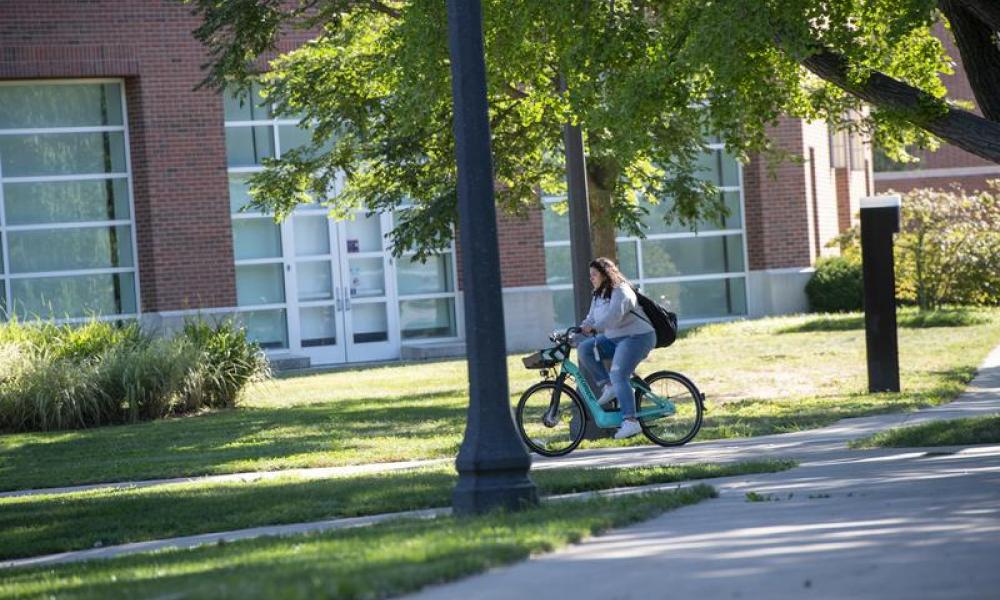
Veoride bike

Bikeshare systems have come a long way since they were first introduced in the Netherlands in the 1960s. They are popular in cities around the world, but how do bike systems affect existing public transportation? That’s the topic of a new paper from the University of Illinois, published in Transportation Research Part A: Policy and Practice.

The researchers study the impact of bikeshare bikes in U of I’s hometown, the midsize metropolitan area of Champaign-Urbana in Central Illinois. The town houses 500 VeoRide bikeshare bikes on campus and in the wider communities, 400 of which are electric. All are dockless, meaning they can be picked up and parked anywhere.

Since VeoRide launched in 2018, Champaign-Urbana has seen an increase in bikeshare riding, while bus ridership in the United States has declined since 2014.

“On one hand, bikeshare has the potential to compete with other transit types due to the convenience and speed (especially electric bikes). On the other hand, bikes might complement bus transit by replacing just a segment of the trip,” says Yilan Xu, associate professor in the Department of Agricultural and Consumer Economics (ACE) at U of I, and co-author on the paper.   

Dockless systems especially