June 27, 2026
3:13 AM
SIL

URBANA, Ill. – The Feed the Future Innovation Lab for Soybean Value Chain Research (Soybean Innovation Lab, “SIL”) at the University of Illinois has been awarded $5 million by the United States Agency for International Development (USAID) to train and empower other Feed the Future Innovation Labs to achieve sustained impact from their innovations. The new award, called “Innovation to Impact” (i2i) 2.0 utilizes an innovative instructional design curriculum and matched management system to support Innovation Lab technology managers as they seek to reduce poverty and malnutrition globally through uptake and scaling of their cutting-edge technologies. Peter Goldsmith directs SIL. Read more from the ACES News

Yilan Xu

URBANA, Ill. – A family’s socioeconomic status affects children’s health long into adulthood. Individuals growing up in low-income families have much higher risk of obesity and obesity-related diseases later in life. That’s especially true for permanent low-income families, a University of Illinois study shows.

“There has been a lot of research connecting parents’ socioeconomic status with children’s future outcomes. Our innovation in this study is to differentiate the importance of two components, which are permanent and transitory income. Each of these would have different policy implications,” says Yilan Xu, associate professor in the Department of Agricultural and Consumer Economics at Illinois, and lead author on the study.

Permanent income is associated with parents’ general socioeconomic conditions in the long term, while transitory income refers to temporary income peaks or valleys. For example, a peak might occur when a parent receives a bonus at work or gets an inheritance. Peaks and valleys might also be related to macroeconomic conditions. Many families experienced a temporary setback due to the economic shock of the COVID-19 pandemic.

Xu and her co-author Tansel Yilmazer, Ohio State University, analyzed data from the Panel Study of Income Dynamics (PSID), which followed thousands of families and children over a

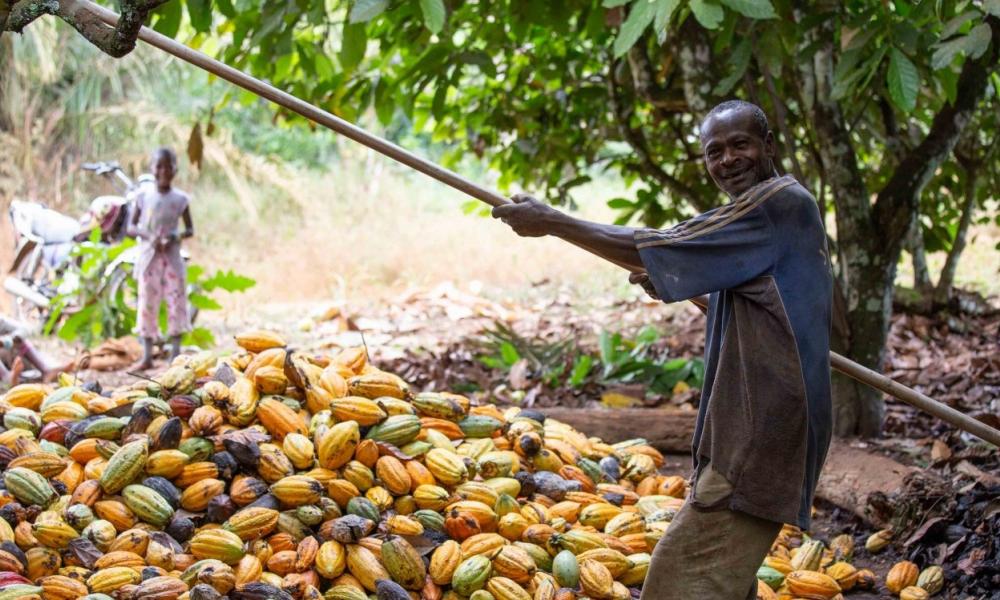
Farm worker

Photo: A farm worker harvests cocoa pods at a cocoa farm in Côte d'Ivoire, by Jorge Sellare.

URBANA, Ill. – While agrifood production is essential for feeding our growing global population, it can also contribute to environmental and social problems, including deforestation, biodiversity loss, poor or precarious labor conditions, and persistent poverty. Certification and standards can encourage use of sustainable production practices, but how effective are such programs in addressing food system challenges? A new study from a team of international researchers reviews the literature on sustainability standards and identifies a series of important questions.

“Our paper summarizes the current state of knowledge about sustainability and certification standards for crop and livestock production,” says Hope Michelson, agricultural economist at the University of Illinois and co-author on the paper. “We look at the impact of standards across different actors in the supply chain. That includes farmers and consumers, as well as institutions that serve as connective tissue in the system: development agencies, processors, wholesalers, and retailers.”

Private groups, governments, and non-government organizations (NGOs) set the standards, which provide guidelines for sustainable production, and compliance is usually voluntary. A variety of different certification schemes exist; some of the largest and most

June 27, 2026
3:13 AM
Alcazar Hotel

(Published in Landmarks magazine, August 2021)

A once thriving hotel and cultural hot spot in Clarksdale, Mississippi, now sits partially gutted and vacant, awaiting a day when it might be brought back to life. The New Alcazar Hotel in Clarksdale is among many buildings in the region that appear on the National Register of Historic Places but are now in disrepair. A former Mississippi State graduate student in the College of Agriculture and Life Sciences analyzed the cultural and economic benefits of restoring structures like the Alcazar.

Kaylee Wells said she hopes the research is a starting point for identifying and possibly prioritizing similar restoration projects in the region. “The goal is not to say whether the Alcazar was worthy of restoration or not, as a statement like that would require knowing the costs of restoring the hotel and also what alternative uses the plot might have if the hotel were razed or repurposed,” she said. “It’s just to provide information so people can make better decisions about how we are using our cultural resources. The Delta has a lot of these, but the question is which ones to restore. This is a first step in that direction.”

Full article

June 27, 2026
3:13 AM
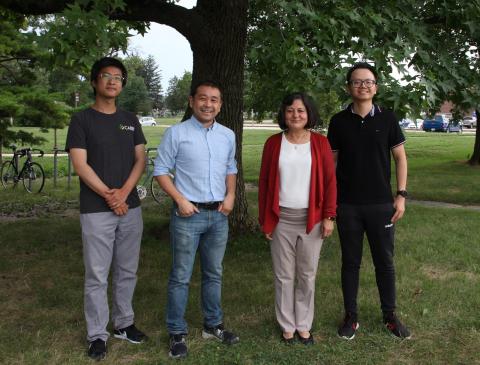
Research group

Land is the planet’s limiting resource. We need land for food, biofuel, feed, ecosystem services, and more. But all land is not equal. Concerns about diverting land under food/feed crops to biofuel feedstocks have led to interest in using marginal land to produce these dedicated bioenergy crops for advanced biofuels. Marginal land has typically been defined as land that is of low quality and not in food crop production. Since energy crops can grow productively on low-quality land, there’s great interest in the potential of energy crops on marginal land to avoid conflict with food production. 

A recent study led by Chongya Jiang, a University of Illinois Research Scientist at the Center for Advanced Bioenergy and Bioproducts Innovation (CABBI), shows that researchers may be overestimating the amount of land that is available for bioenergy crops if they simply look at land that is low quality and low productivity. Results from this study by CABBI, a U.S. Department of Energy (DOE) Bioenergy Research Center, were published in Environmental Science & Technology.

“Sometimes that low productivity land will be in crop production if prices are high and at other times even high productivity land may be idle if crop prices are

June 27, 2026
3:13 AM
Dall'Erba and Ca

(From ACES.illinois.edu)

URBANA, Ill. ­– Most scientists agree climate change has a profound impact on U.S. agricultural production. But estimates vary widely, making it hard to develop mitigation strategies. Two agricultural economists at the University of Illinois take a closer look at how choice of statistical methodology influences climate study results. They also propose a more accurate and place-specific approach to data analysis.

“If you pay attention to forecasts of how the climate will affect U.S. agriculture, the results are completely different. Some scientists predict it's going to have a positive impact for the nation in the long run, some report it's going to have a negative impact,” says study co-author Sandy Dall’Erba, professor in the Department of Agricultural and Consumer Economics (ACE) and director of the Center for Climate, Regional, Environmental and Trade Economics (CREATE) at U of I.

Dall’Erba and Chang Cai, doctoral student in ACE and the paper’s lead author, take stock of all the academic literature that estimates the impact of climate change on U.S. farmland values and revenues, focusing on every U.S. county. The county-level scale is not only more accurate, the researchers say, but also important for regional policy makers, because

June 27, 2026
3:13 AM
hamburger

"Do meal kits reduce food waste? USDA explores potential amid rise in plant-based convenience foods"

(Published on Food Ingredients First on July 29, 2021) - Meal kits have become more popular during the COVID-19 pandemic, with many consumers turning to ready-to-assemble meals and subscription services for food that provides preparation convenience. But do meal kits help reduce food waste?

Brenna Ellison, associate professor at the University of Illinois at Urbana-Champaign, recently shared her insights on the sustainability credentials of meal kits.

“Meal kits are designed to provide households with precise quantities of ingredients to make a specific meal.

They can reduce food waste, particularly for food items that are infrequently used and unavailable in small quantities,” she highlights. More

June 27, 2026
3:13 AM
Doodle of junk food

They may be wiggly, but kids eat more fruit and vegetables when they sit longer at lunch time. Most kids do not choose fruits and vegetables first, but research from the University of Illinois finds that they are more likely to pick those foods the longer they sit - after they eat their favorites, of course.

Melissa Pflugh-Prescott (U of I assistant professor in Food Science and Human Nutrition) discusses the implications in a news article on Science Daily. See the 5-minute read on here.

Co-authors include Xanna Burg, Jessica Metcalfe, and Brenna Ellison

Image by Pencil Parker via Pixabay.

June 27, 2026
3:13 AM
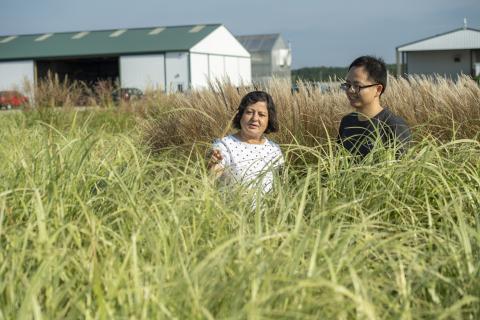
Madhu Khanna with Luoye Chen

Madhu Khanna was selected to serve on a National Academy of Sciences, Engineering, and Medicine Committee that will conduct the study Current Methods for Life Cycle Analyses of Low-Carbon Transportation Fuels in the United States.

The committee will assess current methods for estimating lifecycle greenhouse gas emissions associated with transportation fuels (liquid and non-liquid) for potential use in a national low-carbon fuels program

For more information about this study, please visit Current Methods for Life Cycle Analyses of Low Carbon Transportation Fuels in the United States | National Academies.

June 27, 2026
3:13 AM
Mini-talk speakers

See the full July 2021 newsletter here.

A few highlights include: