Famine Early Warning System

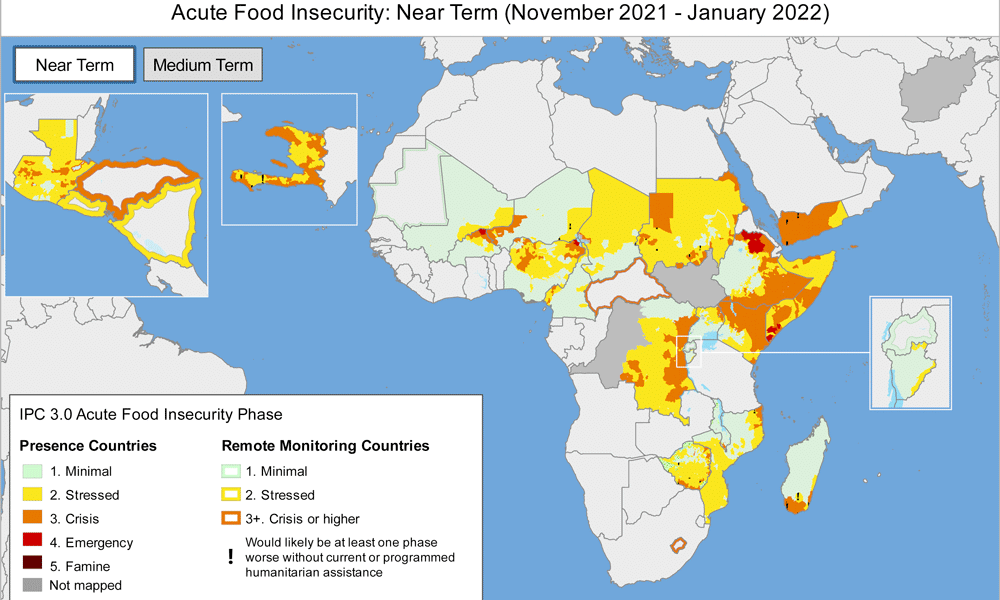
Food insecurity in low-income countries is on the rise as climate variation and economic shocks, including the COVID-19 pandemic, take their toll. Accurately predicting when and where hunger crises occur is critical to effective humanitarian aid response. A new study from the University of Illinois explores how machine learning can help improve forecasting when used appropriately. 

Current food insecurity predictions mostly rely on a system in which groups of experts gather together and assess food insecurity within countries. While the process includes some data to guide assessment, it remains mostly a qualitative evaluation based on local knowledge.

“Our goal is not to overhaul this existing system, which has made incredible contributions across countries, generating predictions about food crises in places where there's very little data and a lot of political complexity,” says Hope Michelson, associate professor in the Department of Agricultural and Consumer Economics at U of I and co-author on the paper.

The study asserts machine learning models can help provide critical information to assist the forecasting process, making it more objective, focused, and transparent. But the authors emphasize data must be used in a thoughtful way and interpreted correctly in conjunction with policymakers from the start. 

“It's really

June 27, 2026
3:06 AM
Madhu Khanna

Madhu Khanna is serving on a committee appointed by the National Academy of Science. The ad hoc committee will assess current methods for estimating lifecycle greenhouse gas (GHG) emissions associated with transportation fuels (liquid and non-liquid) for potential use in a national low-carbon fuels program. More details

June 27, 2026
3:06 AM
cover crop simulation tool

Original article from AgriNews, written by Tom Doran.

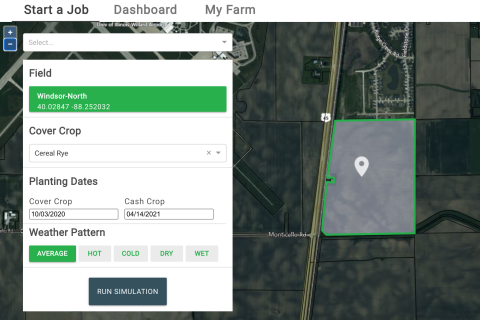
CHAMPAIGN, Ill. — Further updates have been made to a first-of-its-kind web tool to help Illinois farmers manage cover crops.

The free Cover Crop Decision Support Tool was developed by the University of Illinois’ National Center for Supercomputing Applications, with a collaborative team that included agronomists, climatologists and biological engineers.

The goal of the Cover Crop Decision Support Tool — covercrop.ncsa.illinois.edu — is to help provide site-specific answers to decisions not only surrounding the adoption, but also real-time management of cover crops.

Funding for the program is provided by the Illinois Nutrient Research and Education Council and the Walton Family Foundation. Initial seed funding also was provided by the McKnight Foundation and U of I.

Details of the funding and updates were provided in the Dec. 22 Illinois Nutrient Loss Reduction podcast hosted by Todd Gleason, U of I media communications specialist.

Participants were Jonathan Coppess, assistant professor, U of I Agricultural & Consumer Economics; Illinois State Climatologist Trent Ford; Rabin Bhattarai, associate professor, U of I Agricultural & Biological Engineering; and Shalamar Armstrong, associate professor, Purdue University Department of Agronomy.

The updates included providing improved weather forecasts, especially for the spring

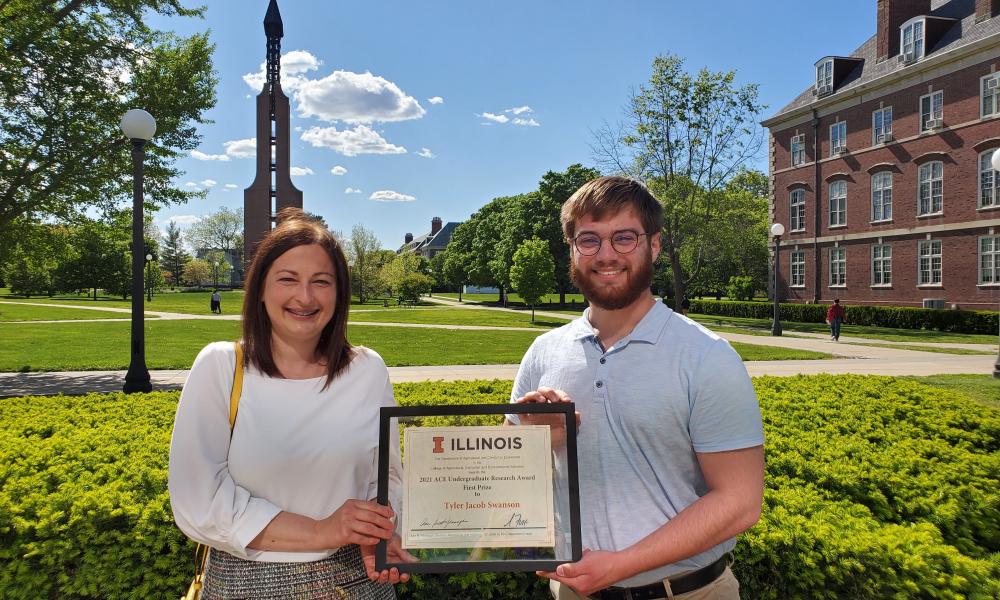
Endres and Swanson

In spring 2021, undergraduate student Tyler Swanson and his advisor Renata Endres (both in the Agricultural and Consumer Economics department) produced an award-winning* research paper studying the interactions of Utility Green Pricing Programs (UGPPs) with renewable energy (RE) generation outcomes entitled “Observations on the Success of Utility Green Pricing Programs in Influencing Renewable Energy Generation".

UGPPs offer customers the option to source their energy from renewable sources by paying a small fee to their utility company. The utility company is able to either utilize their renewable energy sources or purchase it from an RE generator elsewhere.

Recently proposed energy policies in the United States call for the nation to transition to a fully renewable energy grid. States can opt to implement RE policy through Renewable Portfolio Standards (RPS), which mandate RE use by energy companies and thereby individuals. However, research shows that this policy model is not enough on its own, and complementary programs like Utility Green Pricing Programs (UGPPs) incentivize RE development.

“There’s value in consumers having choice in being able to have a leading role in the renewable energy market and energy transition," Swanson says. “People can click a button and pay a few extra bucks a month

Aurelie Harou's photo

View the original article by ACES Research here.

URBANA, Ill. – The right mineral fertilizers applied appropriately can alleviate nutrient deficiencies in soils and increase crop yields, but most small-scale farmers in Sub-Saharan Africa do not have their soils tested to reveal these deficiencies.

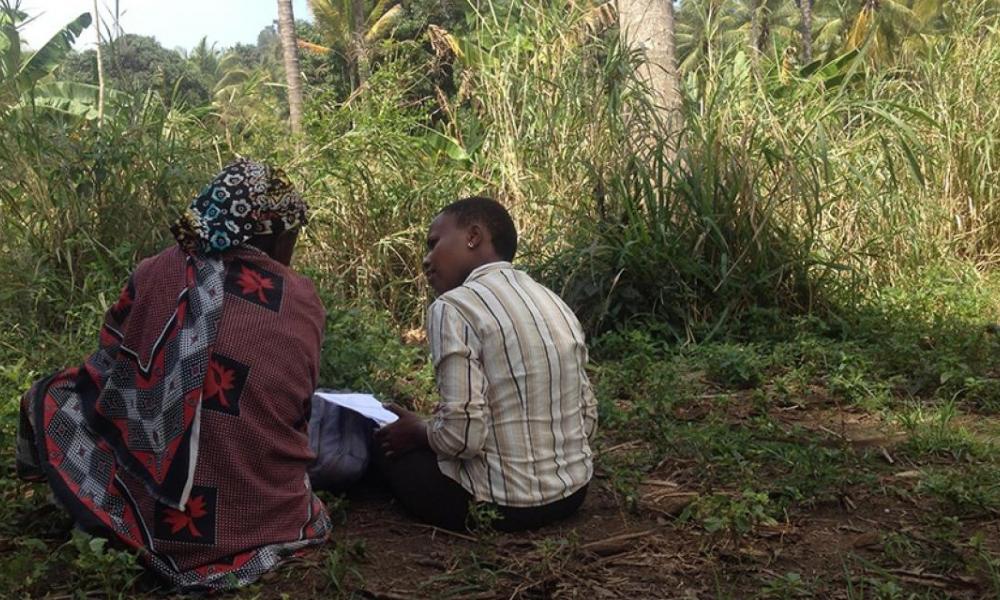
A Tanzania field study shows targeted fertilizer recommendations from low-cost, on-site soil tests paired with subsidies to purchase the recommended fertilizer can increase maize yields on small-scale farms. The soil tests also showed that a change in basic fertilizer recommendations from the government of Tanzania could address an important soil deficiency in Morogoro, where the study took place.

“The result stands out among similar studies because of the magnitude of the yield change – nearly 30% - and its statistical significance,” says Hope Michelson, associate professor of agricultural and consumer economics at the University of Illinois and a principal investigator on the research.

Michelson worked with a multidisciplinary team of soil scientists, agronomists, and agricultural economists from U of I, Sokoine University in Tanzania, University of Florida, and McGill University. The team conducted a randomized controlled trial (RCT) in Tanzania over three years to test the impacts of plot-level soil tests and targeted recommendations. The research was supported

June 27, 2026
3:06 AM
Apartment building

Racial Discrimination and Housing Outcomes in the United States Rental Market

Authors: Peter Christensen, Ignacio Sarmiento-Barbieri & Christopher Timmins recently published by the National Bureau of Economic Research.

Abstract: We report evidence on discriminatory behavior from the largest correspondence study conducted to date in the rental housing market. Using more than 25,000 interactions with rental property managers across the 50 largest U.S. cities, the study reveals that African American and Hispanic/LatinX renters continue to face discriminatory constraints in the majority of U.S. cities although there are important regional differences. Stronger discriminatory constraints on renters of color (particularly African Americans) are also associated with higher levels of residential segregation and larger gaps in intergenerational income mobility. Using matched evidence on the actual rental outcomes at the properties in our experiment, we show that correspondence study measurements of discrimination do indeed predict actual outcomes.

Link to full paper. 

Photo credit: Seyi Ariyo