June 27, 2026
1:47 AM
Solo farmhouse in the Western US

Consumers across the United States worry about the effects of climate change on various parts of the food system. Though concern over issues like land availability, food shortages, and food prices is prevalent in every part of the country, the degree of the population's concern depends on where they live. Notably, concern is higher in the West and Northeast, while it is lower in the South and Midwest. 

Maria Kalaitzandonakes, Jonathan Coppess (University of Illinois) and Brenna Ellison (Purdue) review the results of the Gardner Survey on Farmdoc. 

---

Kalaitzandonakes, M., B. Ellison and J. Coppess. "Climate Change & the Food System: Gardner Survey Results, Part 2." farmdoc daily (12):87, Department of Agricultural and Consumer Economics, University of Illinois at Urbana-Champaign, June 10, 2022.Permalink

Resilient cattle farmer

When households escape poverty, how likely is it they will fall back in the future? Loki Phadera of the World Bank and Hope Michelson of the University of Illinois explain to Tim Phillips why measuring resilience can give us a new perspective on how well anti-poverty programs are working – if only we can agree how to do it.

Listen tot the VoxDevTalk episode below:

Read “Do Asset Transfers Build Household Resilience?” by Lokendra Phadera, Hope Michelson, Alex Winter-Nelson and Peter Goldsmith here

Photo from VoxDevTalks.

June 27, 2026
1:47 AM
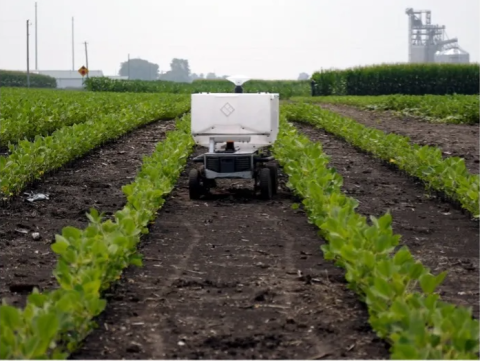
robot in crops

The US Department of Agriculture (USDA) announced in late May that it is funding a new collaboration between two institutes and a research center at the University of Illinois Urbana-Champaign that will create an integrated farm of the future in the US Midwest.

This three-year project, titled I-FARM: Illinois Farming and Regenerative Management, has received $3.9 million in funding from the USDA’s National Institute of Food and Agriculture (NIFA). The Illinois-led study will develop an 80-acre agricultural proving ground where crops (corn and soybeans) and livestock will be raised using synergistic and sustainable methods.

“We will accelerate the creation, maturation and adoption of new management technologies that are fundamentally more sustainable, profitable, affordable and scale neutral. The new practices are enabled by mature digital farming technologies developed in a wide-ranging research effort at the University of Illinois,” said Primary Investigator Girish Chowdhary, Associate Professor of Agricultural and Bioengineering and Computer Science.

Shadi Atallah, Associate Professor of Agricultural and Consumer Economics and CEOS collaborator is on the Illinois team. 

Read the full press release: https://fiorreports.com/usda-nifa-farm-of-the-future-fund-computer-science/

little brown bat

URBANA, Ill. – For years, bats have gotten a bad rap as the creepy creatures lurking in the dark. But for just as long, agricultural producers have known the winged wonder is actually the hero of the story, not the villain.

Now a plague is decimating bat colonies. The culprit: white-nose syndrome. And it’s costing U.S. agriculture up to $495 million each year, according to a recent paper from the University of Illinois and Colorado State University (CSU).

“When bats get this disease it’s often deadly to them, and it’s highly contagious,” says Dale Manning, professor of agricultural and resource economics at CSU, and lead author on the paper, published in the Journal of the Association of Environmental and Resource Economists.

“Lost bat populations have harmful ripple effects on food and agriculture,” adds study co-author Amy Ando, professor of agricultural and consumer economics and co-director of the Center for the Economics of Sustainability at U of I. “Crop yields fall and input costs rise as farmers try to compensate for the services bats usually provide. That drives down the value of farmland and the number of acres planted, and the supply shock probably also hurts consumers as ag

June 27, 2026
1:47 AM
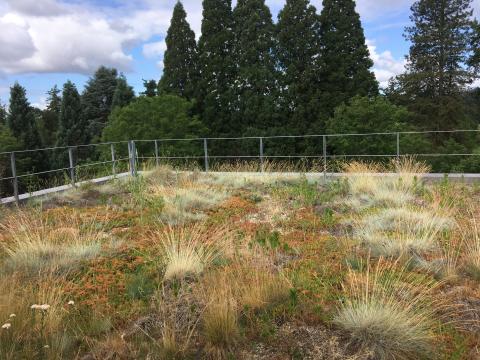
Plant-covered green roof

“Countries are investing significant public resources to reduce the impact of stormwater runoff,” Amy Ando, study author, said in a statement. “Green roofs are part of that solution because they capture some of the rain that would otherwise end up in sewage systems. Knowing the benefits from investing in green roofs is important for implementing public policies.”

new study from Reed College in collaboration with the University of Illinois and Portland State University explores the benefits of green roofs and how much Portland residents are willing to pay to increase the number of green roofs across the city. 

The paper, “Valuing the public benefits of green roofs,” is published in Landscape and Urban Planning [https://doi.org/10.1016/j.landurbplan.2022.104426] and is mentioned in a news piece from ZME Science. 

Authors include Noelwah Netusil, Lauren Lavelle, Sahan Dissanayake, and Amy Ando.

Green roof view PDX

URBANA, Ill. ­– Plant-covered roofs have become a regular sight in Portland, Oregon. The city is a leader in incorporating green infrastructure for stormwater management, including free street trees, rebates for small residential housing footprints, and green roofs.

Green roofs, also known as rooftop gardens or ecoroofs, typically have a layer of plants growing in soil on top of the roof, as well as material for waterproofing, structural support, and insulation. A new study from Reed College in collaboration with the University of Illinois and Portland State University explores the benefits of green roofs and how much Portland residents are willing to pay to increase the number of green roofs across the city.

“Countries around the world are investing significant public resources to reduce the impact of stormwater runoff,” explains Amy Ando, professor of agricultural and consumer economics at U of I, and a co-author on the study. “Green roofs are part of that solution because they capture some of the rain that would otherwise end up in sewage systems. Knowing the benefits from investing in green roofs is important for implementing sound public policies.”

The study investigates how much people would pay for benefits that include reduced sewer

June 27, 2026
1:47 AM
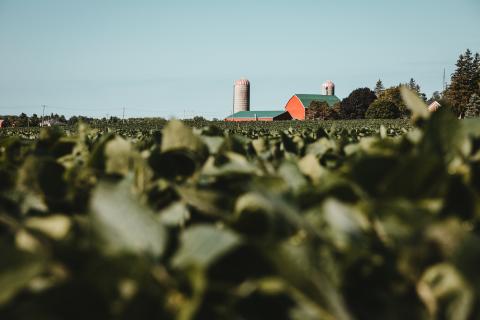
farm with red barn

GENESEO, Ill. — The notion of carbon markets is not new, but has been pushed to the forefront of recent in ramped-up efforts to sequester carbon dioxide.

“The main reason to reduce those emissions is because of climate change concerns and an often-stated goal is to reach carbon neutrality,” said Gary Schnitkey, University of Illinois farm management specialist, in a Wyffels Hybrids-hosted webinar on April 5.

“Agriculture is seen as an activity that’s part of the thing that can reduce carbon emissions. According to 2019 EPA estimates, agriculture produces 10.2% of the greenhouse gases that are emitted in the United States. By far the larger parts of those emissions are transportation, electricity generation and industry.

“Agricultural activities are looked at as a sink for carbon, not as necessarily a part of the problem, and that’s sort of a good place to be and better than some of the alternatives.”

Read the full article on AgriNews